

Legislative Recap
Louisiana FY2026–27 Budget: Final Priorities & What They Mean for You
Stephen Wright · JUNE 18, 2026
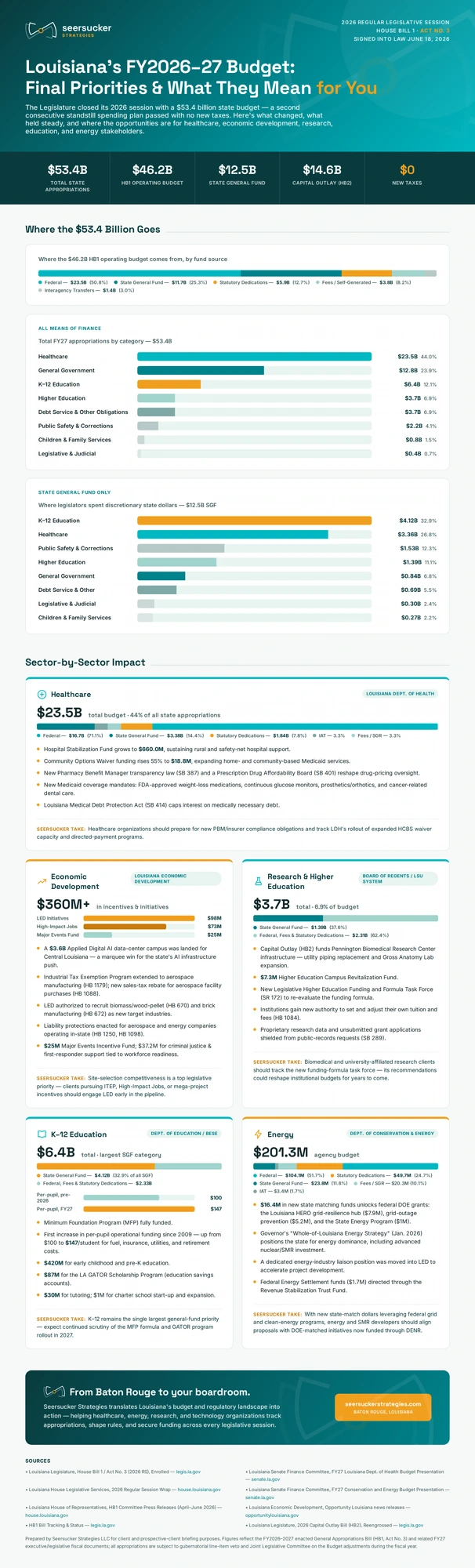
The Legislature closed its 2026 session with a $53.4 billion state budget — a second consecutive standstill spending plan passed with no new taxes. Here is what changed, what held steady, and where the opportunities are for healthcare, economic development, research, education, and energy stakeholders.
The Legislature closed its 2026 session with a $53.4 billion state budget — a second consecutive standstill spending plan passed with no new taxes. Here is what changed, what held steady, and where the opportunities are for healthcare, economic development, research, education, and energy stakeholders.
The Louisiana Legislature closed its 2026 session with a $53.4 billion total state budget — a second consecutive standstill spending plan passed with no new taxes. Below is the Seersucker Strategies breakdown of where the money goes, sector by sector, and what each shift means for our clients.
Where the $53.4 billion goes
The $46.2B HB1 Operating Budget is funded by Federal ($23.5B), State General Fund ($11.7B), Statutory Dedications ($5.9B), Fees / Self-Generated ($3.8B), and Interagency Transfers ($1.4B). Healthcare receives the largest allocation — $23.5B (44%) — followed by General Government ($12.8B) and K-12 Education ($6.4B).
Discretionary State General Fund — $12.5B
K-12 Education leads discretionary spending at $4.12B, followed by Healthcare ($3.36B), Public Safety & Corrections ($1.53B), and Higher Education ($1.39B).
Healthcare — $23.5B
Hospital Stabilization Fund grows to $660.0M
Community Options Waiver funding rises 55% to $18.8M
New Pharmacy Benefit Manager transparency law (SB 387) and Prescription Drug Affordability Board (SB 401)
New Medicaid coverage mandates (FDA-approved weight-loss meds, CGMs, prosthetics/orthotics, cancer-related dental care)
Louisiana Medical Debt Protection Act (SB 414)
Seersucker take: healthcare organizations should prepare for new PBM/insurer compliance obligations and track LDH s rollout of expanded HCBS waiver capacity and directed-payment programs.
Economic Development — $360M+
Applied Digital AI data-center campus lands for Central Louisiana ($3.6B). Industrial Tax Exemption extended to aerospace; LED authorized to recruit biomass/wood-pellet and brick manufacturing.
Seersucker take: site-selection competitiveness is a top legislative priority — clients pursuing ITEP, High-Impact Jobs, or mega-project incentives should engage LED early in the pipeline.
Research & Higher Education — $3.7B
Capital Outlay (HB2) funds Pennington Biomedical infrastructure
$7.3M Higher Education Campus Revitalization Fund
New Legislative Higher Education Funding and Formula Task Force (SR 172)
Institutions gain authority to set and adjust their own tuition and fees (HB 1084)
K-12 Education — $6.4B
MFP fully funded. First per-pupil operational increase since 2009 — from $100 to $147/student.
Energy — $201.3M
$16.4M in state matching funds unlocks federal DOE grants (Louisiana HERO grid-resilience hub, grid-outage prevention, State Energy Program)
Governor s Whole-of-Louisiana Energy Strategy (Jan. 2026) positions the state for energy dominance, including advanced nuclear/SMR investment
A dedicated energy legislative liaison was moved into LED to accelerate project development
Seersucker take: with new state-match dollars leveraging federal grid and clean-energy programs, energy and SMR developers should align proposals with DOE-matched initiatives now funded through DENR.
From Baton Rouge to your boardroom
Seersucker Strategies translates Louisiana s budget and regulatory landscape into action — helping healthcare, energy, research, and technology organizations track appropriations, shape rules, and secure funding across every legislative session.