
Infrastructure & Grants
$235 Million Awarded, None in Louisiana, Mississippi, or Alabama: Local Leaders Have Until November 16 to Apply
Stephen Wright · SEPTEMBER 30, 2026
The Federal Highway Administration opened the final funded round of the Wildlife Crossings Pilot Program today: about $80 million for projects that cut collisions between vehicles and wildlife. Parishes, counties, cities, and MPOs can apply directly. Applications are due November 16.
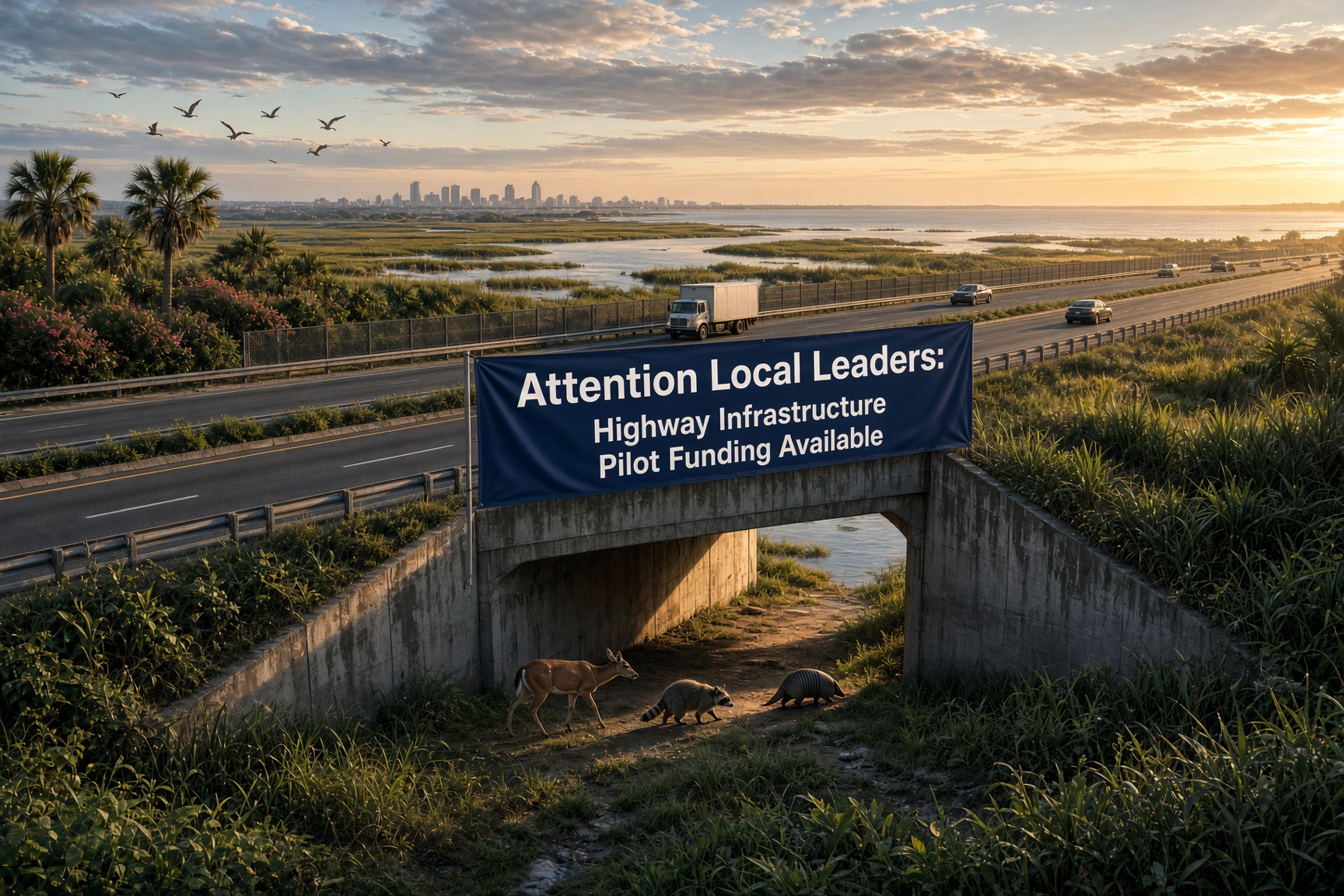
The Federal Highway Administration today released the fiscal year 2026 notice for the Wildlife Crossings Pilot Program, offering approximately $80 million in reimbursable grants, plus any unspent money from earlier years. Applications are due through Grants.gov by 11:59 p.m. Eastern on November 16, 2026. That leaves about seven weeks.
Over its first two rounds, the program awarded roughly $235 million to 35 projects. Not one went to Louisiana, Mississippi, or Alabama. Florida’s DOT won $6.1 million for a crossing and fencing on US-27 in Highlands County. Georgia’s DOT received $2.2 million for a statewide collision-reduction framework. Texas secured an ocelot underpass through the U.S. Fish and Wildlife Service. The three central Gulf states, where rural two-lane highways cut through miles of deer habitat, came away with nothing.
This round is also the last year of the program’s five-year, $350 million authorization under the Infrastructure Investment and Jobs Act. Whether it continues depends on the next surface transportation reauthorization, which Congress has not yet written.
The risk on Gulf South roads
MississippiAnimal-collision odds (State Farm, Jul. 2025 to Jun. 2026): 1 in 81; Deaths in animal collisions, 2015 to 2024 (IIHS): 26; Rural non-Interstate fatality rate per 100M VMT (TRIP, 2022): 1.93; Fatality rate, all other roads: 1.61
AlabamaAnimal-collision odds (State Farm, Jul. 2025 to Jun. 2026): 1 in 109; Deaths in animal collisions, 2015 to 2024 (IIHS): 27; Rural non-Interstate fatality rate per 100M VMT (TRIP, 2022): 2.15; Fatality rate, all other roads: 1.03
LouisianaAnimal-collision odds (State Farm, Jul. 2025 to Jun. 2026): 1 in 215; Deaths in animal collisions, 2015 to 2024 (IIHS): 17; Rural non-Interstate fatality rate per 100M VMT (TRIP, 2022): 2.57; Fatality rate, all other roads: 1.29
United StatesAnimal-collision odds (State Farm, Jul. 2025 to Jun. 2026): 1 in 145; Deaths in animal collisions, 2015 to 2024 (IIHS): 210 in 2024 alone; Rural non-Interstate fatality rate per 100M VMT (TRIP, 2022): 2.01; Fatality rate, all other roads: 1.12
Mississippi drivers face close to twice the national odds of an animal collision and rank among State Farm’s ten highest-risk states. Alabama’s odds also run above the national average. Across the three states, 70 people died in collisions with animals over the last decade of federal crash data.
Louisiana’s statewide odds sit below the national figure, and that number deserves a careful reading. It averages the Baton Rouge, New Orleans, and Lafayette metros together with rural parishes where the risk actually concentrates. On Louisiana’s rural non-Interstate roads, the fatality rate is double the rate on every other road in the state and the ninth highest in the nation. Those death counts include only crashes in which a vehicle struck an animal. They leave out the driver who swerves to miss a deer on a narrow rural highway and hits a tree instead.
The costs extend past the crash itself. FHWA counts more than a million wildlife-vehicle collisions each year nationwide, with an economic toll above $8 billion. AAA’s East Central region put the average deer-collision claim at about $5,620 in 2024. And timing matters: State Farm’s data puts October, November, and December at the top of the list for animal strikes. The application window runs straight through the season when the problem is at its worst.
Why local governments should apply without waiting on the state
Eligibility is broader than most local officials assume. State DOTs can apply, but so can metropolitan planning organizations, units of local government, regional transportation authorities, special districts with a transportation function, tribes, federal land management agencies, and any group of those entities. Universities, nonprofits, and foundations can join as partners. There is no minimum or maximum award.
Three features of this notice favor a first-time Gulf South applicant. At least 60 percent of each year’s funds must go to rural areas. The notice lets DOT weigh geographic distribution and a mix of new recipients when choosing among similarly rated projects. And the first round showed that planning work wins: Missouri received $320,000 for a statewide hotspot analysis, South Dakota $400,000 for a rural crossing study, and Kentucky $1.2 million for a collision-reduction plan. DOT may give an edge to construction, but a well-scoped study led by a parish, county, or MPO is a realistic first application. It also builds the record any future construction request will need.
The Capital Region Planning Commission in Baton Rouge, the Gulf Regional Planning Commission on the Mississippi Coast, and the South Alabama Regional Planning Commission in Mobile already hold the crash data and the federal compliance experience these applications require. A rural parish or county that partners with one of them starts well ahead of one that applies alone.
The 20 percent problem
Every recipient must supply a 20 percent non-federal match, and applicants who do not show it are ruled ineligible. The match must come from state or local revenue or from private funds. Costs already spent do not count. On a $400,000 study, that is $80,000. On a $5 million crossing with fencing, it is $1 million, which exceeds the entire capital budget of many rural police juries and county commissions.
The payment structure adds a second strain. For state and local recipients these are reimbursement grants: the applicant pays first and FHWA pays back eligible costs incurred after the grant agreement is signed. Awards are expected in March 2027, and the money must be obligated by September 30, 2029.
The notice leaves several routes around the match:
A state partner. LaDOTD, MDOT, or ALDOT can contribute state funds to a local government’s application or co-apply as part of a group.
Private and institutional partners. Foundations, conservation nonprofits, and universities can put cash into the match. Leveraging non-federal money is also a scored consideration, so a partner’s contribution helps twice.
The federal safety share. The notice states that certain safety projects may qualify for a 100 percent federal share under 23 U.S.C. 120(c)(1). Applicants should ask their FHWA division office this week whether their project fits.
Federal land partners. Federal land management agencies can meet the match with other allowable federal funds. The Kisatchie National Forest in Louisiana, the De Soto in Mississippi, and the Conecuh in Alabama all border rural highways.
What reviewers will score
The notice rates applications on two primary criteria. The first is collision reduction: a baseline of current collisions, the landscape and migration context, the factors behind the crashes, and how well the proposed fix works. The second is habitat connectivity, and aquatic species count. A coastal box culvert or bridge replacement that restores fish passage can score here. On design, the evidence is consistent: research compiled by Pew and the Center for Large Landscape Conservation finds that crossings paired with fencing cut wildlife-vehicle collisions by more than 80 percent.
Projects that clear that bar are then judged on five secondary considerations: leveraging non-federal money, supporting economic development and visitor opportunities, using new technology, offering education and outreach, and building in monitoring. A readiness review follows, covering technical capacity, cost estimates, and permitting risk.
Seersucker Strategies helps local governments and associations scope, partner, and write federal grant applications.
Sources: U.S. DOT Federal Highway Administration, FY 2026 Wildlife Crossings Pilot Program Notice of Funding Opportunity (FHWA-WCPP-26-002) and FY 2022-2023 grant selections; AASHTO Journal, FY 2024-2025 award announcement; State Farm, animal collision data, July 2025 to June 2026; Insurance Institute for Highway Safety, Fatality Facts 2024; TRIP, “Rural Connections” (September 2024); AAA East Central; The Pew Charitable Trusts and Center for Large Landscape Conservation, “Reducing Wildlife-Vehicle Collisions by Building Crossings.”